27. Oktober 2026 in Interview
Bishop Fredrik Hansen (Oslo) in an interview with KATH.NET: “If I were to question that faith, to criticize that faith, I would fail in my duty as teacher and cause doubt and uncertainty. This would be wrong.” Von Petra Lorleberg
Oslo (kath.net/pl) “When I was appointed a bishop, several of the initial interviews in Norway asked me if I believed in this or if I believed in that. These questions surprised me. Both as a Catholic and as a bishop, the faith of the Church is the faith that has been handed to me and to which I have subscribed.” Fredrik Hansen, the Bishop of Oslo, draws attention to this in an interview with KATH.NET.
At 47, Fredrik Hansen is a young bishop. At the same time, he possesses an exceptional level of international experience: he received a doctorate in canon law from the Pontifical Gregorian University in Rome, served as vice-rector of the Collegio Teutonico di Santa Maria dell’Anima in Rome, and later worked in the Vatican’s diplomatic service—with postings in places including Honduras and Vienna—before his episcopal ordination on January 18, 2025, at which the Vatican’s Cardinal Secretary of State, Pietro Parolin, served as the principal consecrator.
kath.net: Bishop Hansen, at the age of 20, you converted from the Lutheran Church into full communion with the Roman Catholic Church. What was it that drew you in at the time, prompting you to take the—by no means easy—path of conversion?
Bishop Hansen: At the time of my conversion (late 1990s/early 2000s), several significant and very public debates were taking place within the Lutheran Church of Norway. These debates concerned the Eucharist, the role of the bishops, and authority in the church.
Like all active Lutherans in Norway, I spent much time thinking and praying over these questions. It became clear to me that my faith in the Eucharist and my understanding of Church and Church authority was Catholic. As a result, the right course of action was to seek full communion.
kath.net: Did you find in the Catholic Church what you were looking for back then?
Bishop Hansen: Yes. I remember still the peace and calm of attending Mass, of witnessing the consecration of the Body and Blood of Christ, of receiving Holy Communion, and of “resting” in the faith of the Church during my initial months as a Catholic.
These aspects of the Catholic faith and life as a member of the Church remain central to me to this day.
kath.net: You gained extensive international experience early on, and now, within the Catholic Church in Norway, you are once again operating in a multicultural environment. What significance do terms like “internationality” and the „universal nature of the Church” hold for you?
Bishop Hansen: As so many years of my priestly ministry have taken place abroad and in very international contexts and I now govern a diocese that is the “universal church in every parish”, internationality and world-church-ness is very much part of me. I made the point when I was appointed a bishop that I have felt at home in every place I have been asked to minister.
I think this is true in large part because we are all at home in the Church, always and everywhere, in the faith, in the sacramental life, and under the shepherds of the Church.
kath.net: You have announced the convocation of a diocesan synod. Should we envision this along the lines of the “Synodal Path” in Germany, or more in the spirit of the Vatican’s universal Synod—or will Norwegian Catholics develop a style of their own?
Bishop Hansen: The Diocesan Synod of Oslo will be precisely that, a diocesan synod. This is a venerable institution in the life of the Church, clearly defined in canon law, and an instrument of the bishop’s governance that time and time again has proven its value. I have pointed to the post-tridentine synods of St. Charles Borromeo as an example of the Diocesan Synod.
Our Diocesan Synod will be dedicated to the elaboration of a new and comprehensive pastoral plan, new statutes for the pastoral council, parish council, and parish financial councils, all within a view of fortifying evangelization and the broader pastoral life of our parishes.
kath.net: What are the most pressing issues for Catholics in Norway today?
Bishop Hansen: I would point to two: Evangelization of the youth and the care of our migrant communities. Like most of the Church, Catholics in Norway wish to strengthen our efforts to hand on the faith and encourage an active and devoted Christian life in the younger generations.
In our world and in Norwegian society, that will require both the transmission of the deposit of faith and providing young people with the assistance needed to live as Catholics, today and tomorrow.
The Diocese of Oslo is a migrant diocese, most parishes have Mass in several languages, there are many national chaplains, and many groups have catechesis in their own language. How will this develop in the future? We know that there will be fewer priests from abroad, we know that second and third generation migrants are more fluent in Norwegian, we know that we need to strengthen the unity and common action in our parishes. This needs much thought and planning. Both topics will figure in the work of the diocesan synod.
kath.net: What importance does the Catholic Magisterium hold for you personally, as well as for your role as a shepherd of your diocese?
Bishop Hansen: When I was appointed a bishop, several of the initial interviews in Norway asked me if I believed in this or if I believed in that. These questions surprised me. Both as a Catholic and as a bishop, the faith of the Church is the faith that has been handed to me and to which I have subscribed.
As a bishop, my duty is to proclaim the faith of the Church. If I were to that faith, to criticize that faith, I would fail in my duty as teacher and cause doubt and uncertainty. This would be wrong.
kath.net: The Catholic Church in Norway is small, but it is growing. This growth is driven not only by the arrival of Catholics from abroad but also by conversions to the Catholic faith. What reasons do people give for their decision to join the Catholic Church?
Bishop Hansen: Those that seek to learn more about the Catholic faith and those who seek full communion or adult baptism, in large part, speak of their search for truth, for clear teaching, for reverent liturgy, for true Christian community.
In other words, they seek Jesus Christ, his law proclaimed, his mysteries celebrated, and his disciplines united in charity.
kath.net: Bishop Hansen, what can we German-speaking Catholics learn from the Catholics in Norway? Do you have a message for our readers?
Bishop Hansen: Be people of hope! As Our Lord has told us: “I have conquered the world” (Joh 16.33).
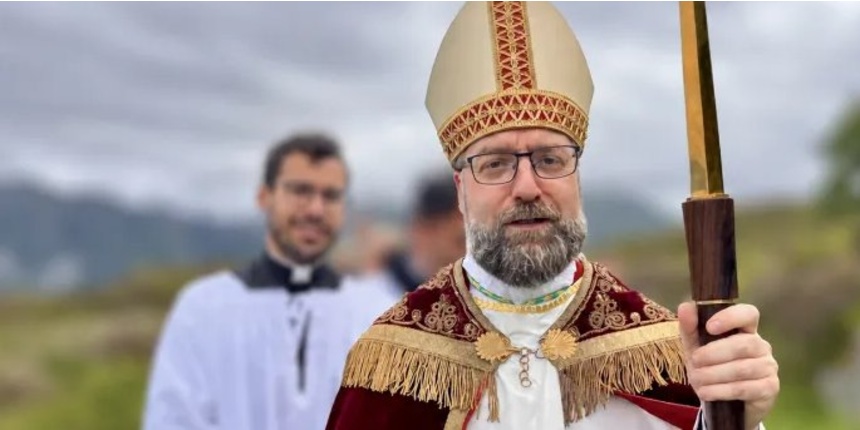
Photo: Bishop Hansen during the procession at the Seljumanna Mass in 20266 (c) Marta Wade/katolsk.no
© 2026 www.kath.net