 |
Loginoder neu registrieren? |
|||||
              
| ||||||
 SucheSuchen Sie im kath.net Archiv in über 70000 Artikeln:     Top-15meist-diskutiert
| 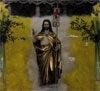 Jesus of Nazareth, the Pope's path towards Jesus14. April 2007 in English, keine Lesermeinung The new book of Pope Benedict XVI can be owned from Monday. Vatican City (www.kath.net/VIS) The Italian publishing house, Rizzoli, entrusted by the Vatican Publishing House with the sale of the rights of the book throughout the world, today released a press communique stating that "'Jesus of Nazareth' is the first part of a two-volume work examining Jesus' public life from His Baptism in the Jordan to the Transfiguration." "On the one hand," the communique continues, "this is a pastoral narrative ... offering an introduction to the principles of Christianity. ... On the other, the text is an essay that maintains the strict academic discipline that distinguish the writings and talks of the theologian Joseph Ratzinger. "The pastoral concerns of the Pope," it adds, "and his exceptional theological doctrine, come together to focus on the central theme of the work: the conviction that, in order to understand the figure of Jesus Christ, it is necessary to start from His union with the Father. "A historical-critical methodology is indispensable for serious exegesis." Such a methodology "has granted access to a great quantity of material and knowledge that enable us to reconstruct the figure of Jesus with a profundity unimaginable a few decades ago. Nonetheless, only faith can lead to the understanding that Jesus is God; and if in the light of this conviction the sacred texts are read with the instruments of modern historical-critical methodology, ... they reveal ... a figure worthy of faith. "For Joseph Ratzinger, faith and critical research are complementary, not antagonistic, and the Jesus of the Gospels is the historical Jesus," the communique concludes. A synopsis of the new volume, entitled "the Pope's path towards Jesus," makes it clear that this book "reflects the personal search by Joseph Ratzinger for the 'face of Jesus,' and is not a document of the Magisterium." "For Benedict XVI, the biblical text contains all the elements to affirm that the historical figure of Jesus Christ is also in fact the Son of God, Who came to earth to save humankind." "Based on the intimate unity between the Old and New Testament, and employing Christological hermeneutics which see in Jesus Christ to the key to the entire Bible, Joseph Ratzinger presents the Jesus of the Gospels as the 'new Moses' Who fulfills the ancient expectations of Israel. This new and true Moses must lead the people of God to real and definitive freedom. He does so through successive steps which, nonetheless, always allow God's plan to be seen in its entirety." In this light, "the immersion of Jesus in the waters of the Jordan is the symbol of His death and descent into hell, a reality that accompanied Him throughout His life. In order to save humanity, ... He had to overcome the principal temptations that in different forms threaten mankind of all times and, transforming them into obedience, reopen the way towards God, towards the Promised Land which is the Kingdom of God." "The theme of the 'Kingdom of God' which runs throughout Jesus' announcement is given deeper consideration in the Pope's reflection on the Sermon on the Mount, ... in which the Beatitudes constitute the main points of the new Law and, at the same time, represent a self-portrait of Jesus." The Sermon "shows that this Law is not just, as in Moses' case, the result of a 'face to face' meeting with God, but carries in itself the fullness that arises from Jesus' intimate union with the Father." Hence, a "fundamental element" of man's life is "talking and listening to God. And for this reason Benedict XVI has dedicated an entire chapter to prayer, explaining the Our Father that Jesus Himself taught us." The synopsis continues: "The profound contact of men and women with God the Father through Jesus in the Holy Spirit brings them together in the 'us' of a new family which, with the choosing of the Twelve, recalls the origins of Israel. ... Even in its highly varied composition, the new family of Jesus, the Church of all times, finds in Him the unifying center and the guidance to live the universal nature of His Gospel. "In order to make the content of His message more accessible and to turn it into a form of practical guidance, Jesus used parables. ... However, there is also a purely theological explanation of the meaning of the parables, and Joseph Ratzinger highlights this in a singularly profound analysis." The Holy Father's book then goes on to consider "the metaphors used by Jesus to explain His mystery." These are "the great images of St. John," but "before analyzing them the Pope presents a very interesting summary of the various results of academic research into who John the Evangelist was," and "opens new horizons for readers, revealing Jesus ever more clearly as the 'Word of God'." "This point of view is broadened further in the last two chapters of the book ... where the true mission of the Messiah of God and the destiny of those who follow Him is definitively established." Finally "an in-depth analysis of the titles which, according to the Gospels, Jesus used for Himself, concludes the Pontiff's book." "Alongside the man of faith, ... alongside the highly sophisticated theologian, ... what also emerges from this book is the pastor who truly manages to 'encourage in readers the growth of a living relationship' with Jesus Christ. ... In this light," the synopsis concludes, "the Pontiff is not afraid to tell the world that, by excluding God and clinging only to visible and material reality, we risk self destruction in the selfish search for a purely material wellbeing," while renouncing the possibility "of achieving true freedom in the 'Promised Land,' the 'Kingdom of God'."
Ihnen hat der Artikel gefallen? Bitte helfen Sie kath.net und spenden Sie jetzt via Überweisung oder Kreditkarte/Paypal!  LesermeinungenUm selbst Kommentare verfassen zu können müssen Sie sich bitte einloggen. Für die Kommentiermöglichkeit von kath.net-Artikeln müssen Sie sich bei kathLogin registrieren. Die Kommentare werden von Moderatoren stichprobenartig überprüft und freigeschaltet. Ein Anrecht auf Freischaltung besteht nicht. Ein Kommentar ist auf 1000 Zeichen beschränkt. Die Kommentare geben nicht notwendigerweise die Meinung der Redaktion wieder. |  Mehr zuEnglish
|       Top-15meist-gelesen
| |||
 | ||||||
© 2026 kath.net | Impressum | Datenschutz | ||||||
